










Ultratooth dental implants are an immediate-load approach to replacing missing teeth, invented by Dr. Sargon Lazarof. They are a strong option for people missing one tooth, several teeth, or all their teeth who don’t want to spend months with a gap or a removable denture. A qualified patient can often leave the same visit with an implant and a fixed temporary tooth in place.
This page covers how Ultratooth works, its advantages, the procedure, the risks to consider, and how to care for the implant afterward.
What Are Ultratooth Dental Implants?
Ultratooth is a patented immediate-load dental implant system developed by Dr. Sargon Lazarof, a USC School of Dentistry graduate who later served as a Clinical Professor there. The implant is placed in the jawbone, where it acts as a replacement tooth root and supports a fixed crown, bridge, or full set of teeth.
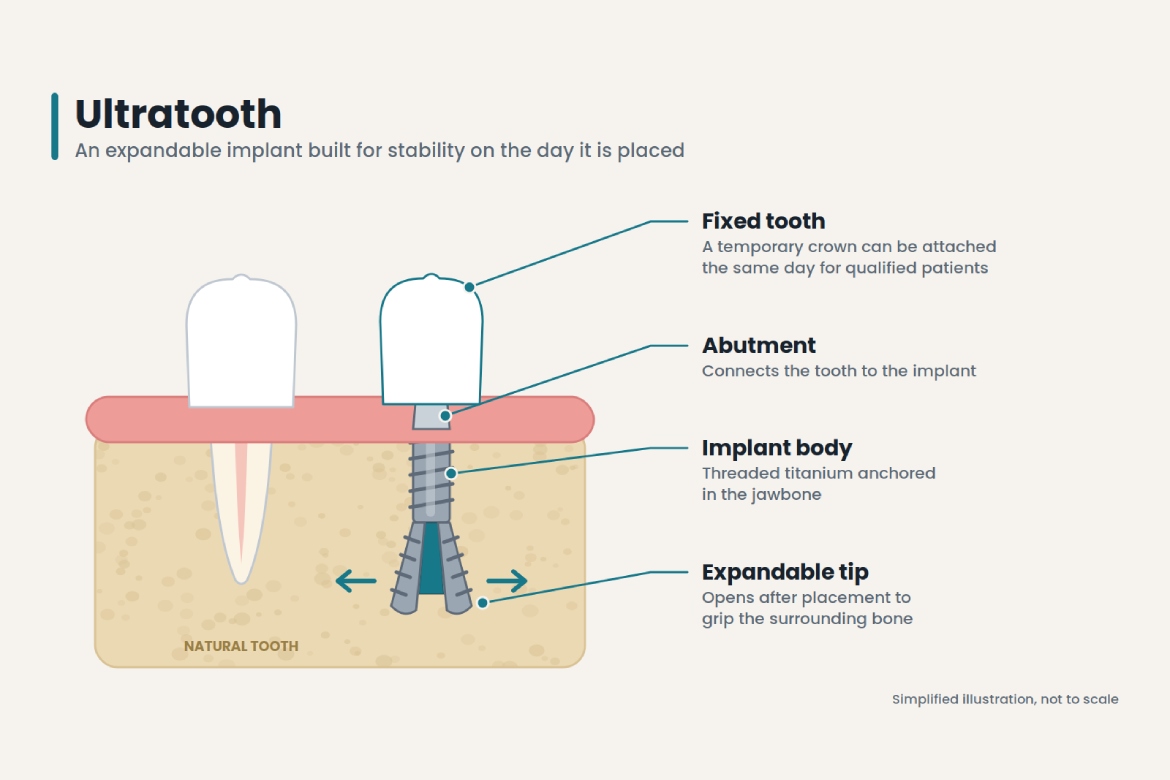
What sets Ultratooth apart is how it holds on day one. A conventional implant depends mainly on its threads for early grip. Ultratooth adds an expandable section at the tip, which the dentist opens after placement so the implant presses firmly against the surrounding bone.

Advantages
- Immediate results. Qualified patients can receive a fixed temporary tooth on the day the implant is placed, so there is no visible gap during healing.
- Stability from day one. The expandable tip is engineered to create a strong mechanical grip in the bone at placement, which is the main requirement for immediate loading.
- Healthy teeth stay untouched. A single Ultratooth implant stands on its own. Neighboring teeth do not need to be ground down to hold a bridge.
- Bone preservation. Like other implants, Ultratooth replaces the tooth root and keeps the jawbone working, which helps limit the bone loss that follows a missing tooth.
- Possible alternative to grafting. In selected cases, the expandable design helps the dentist work with the bone that is already there.
- Natural look and function. The final tooth is fixed in place and shaped to blend with the rest of the smile, so chewing and speaking feel familiar.
- Flexible treatment. The same system can replace one tooth, several teeth, or a full mouth.
What Ultratooth Can Replace
Ultratooth isn’t limited to one type of case. The plan depends on how many teeth are missing and where they are.
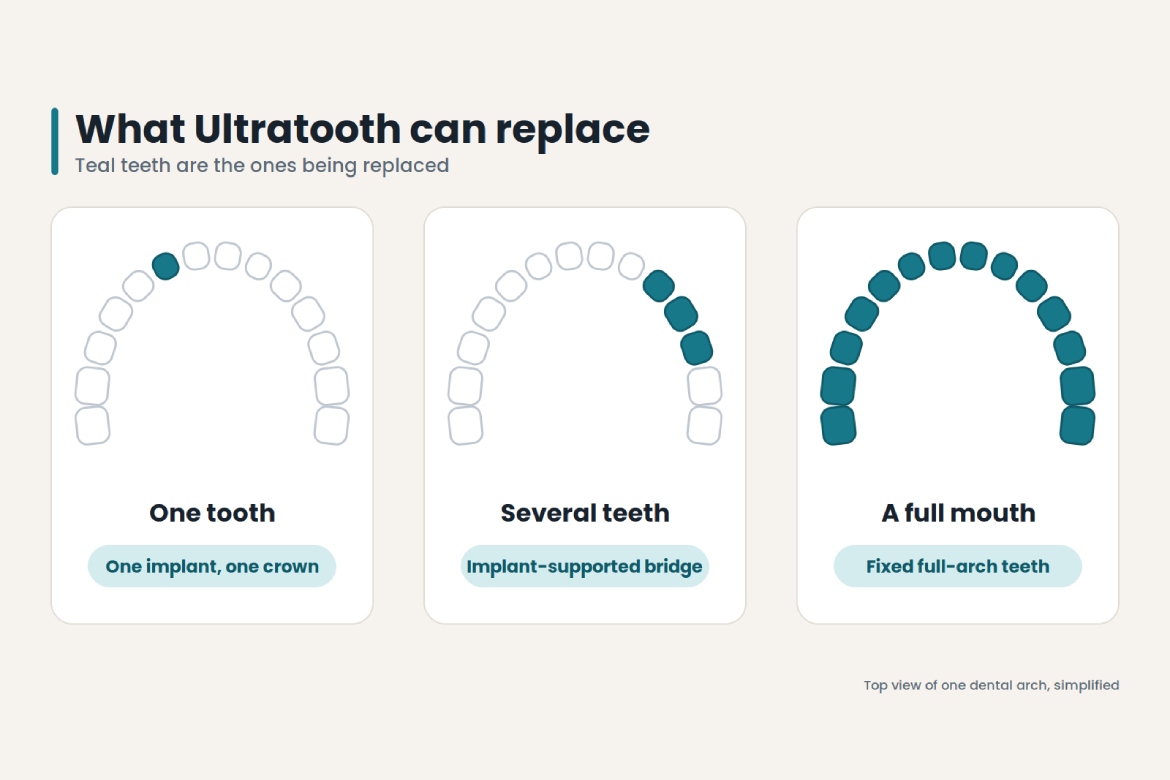
- A single tooth. One implant supports one crown. This is common when a damaged or infected tooth must be extracted, and in suitable cases, the implant is placed during the same visit as the extraction.
- Several teeth. Two or more implants can support an implant bridge. The number and position depend on bone, bite forces, and bridge design.
- A full mouth. Patients who have lost most or all of their teeth may qualify for fixed full-arch teeth supported by implants, as an alternative to removable dentures.
The Procedure
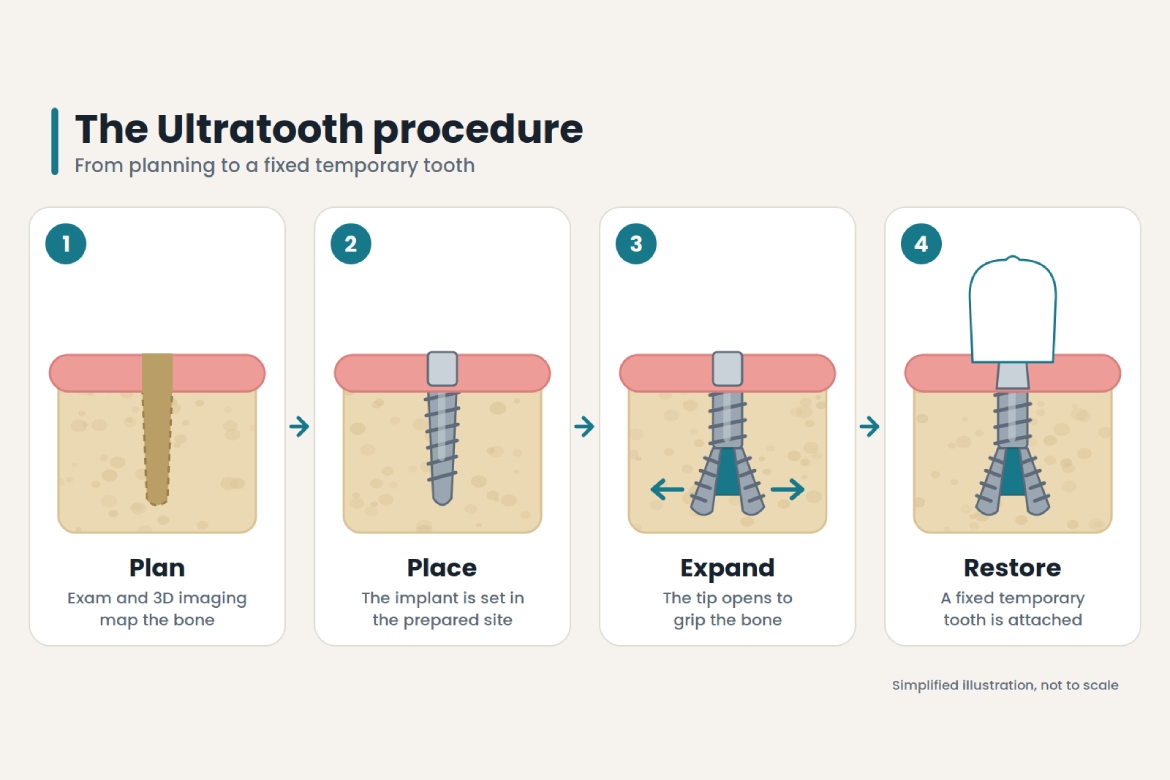
- Consultation. Treatment starts with a dental examination, a review of medical history, and 3D imaging to measure bone and map nearby nerves and sinuses.
- Digital planning. The dentist chooses the implant’s position, size, and type and decides whether immediate loading is appropriate.
- Extraction, when needed. The dentist carefully removes a tooth that cannot be saved to protect the surrounding bone and gum.
- Implant placement and expansion. The Ultratooth implant is positioned in the prepared site. Its expansion mechanism is then activated so the tip engages the bone and locks the implant in place.
- Temporary tooth. When stability and other clinical criteria are met, a fixed temporary tooth is attached in the same appointment.
- Healing period. Bone and gum tissue heal around the implant over the following months. Patients follow a softer diet and return for follow-up visits.
- Permanent restoration. Once healing is confirmed, the dentist makes and fits the final crown, bridge, or full-arch restoration.
Local anesthesia is used during placement, and sedation is available for patients who are anxious or having more extensive treatment. Some tenderness and swelling afterward are normal.
Considerations and Risks
- Not everyone qualifies for a same-day tooth. Immediate loading depends on the implant reaching enough stability. When it does not, a staged approach with a longer healing period is the safer path.
- Bone density. Adequate jawbone is still required. The expandable design may reduce the need for grafting in selected cases, but no implant system removes that need for every patient.
- Oral health. Gum disease or active infection usually has to be treated first. Smoking, certain medications, and some medical conditions also affect healing.
- Bite forces during healing. The implant is mechanically stable on day one but still healing biologically. Heavy chewing on a new implant can interfere with the bond between the implant and bone.
- Cost. Implants cost more upfront than dentures or a traditional bridge. The fee depends on the number of teeth, extractions, any bone work, the type of restoration, and sedation.
- Surgical risks. As with any oral surgery, infection, swelling, and discomfort are possible. Careful planning and aftercare keep these risks low.
How Ultratooth Compares With All-on-4
Both treatments can deliver fixed teeth on the day of surgery, but they solve different problems. All-on-4 dental implants replace an entire arch on four implants, while Ultratooth can replace as little as one tooth.
| Factor | Ultratooth | All-on-4 |
|---|---|---|
| Type of treatment | Immediate-load implant system | Full-arch treatment concept |
| Teeth replaced | One tooth, several teeth, or a full mouth | Every tooth in one arch |
| Implants used | Planned case by case | Four per arch |
| How early stability is achieved | Expandable tip opened after placement | Two straight front implants and two angled back implants |
| Remaining healthy teeth | Can stay in place | Removed in the treated arch |
| Same-day teeth | Fixed temporary tooth for qualified patients | Temporary full-arch teeth in many cases |
| Best suited to | Patients replacing only the teeth they have lost | Patients who have lost most or all teeth in an arch |
Maintenance
- Regular cleaning. Brush twice a day and clean between the teeth daily. A single implant crown is flossed much like a natural tooth, and a bridge needs cleaning underneath with a water flosser or small brushes.
- A softer diet at first. Follow the eating instructions you are given during healing so you don’t overload the new implant.
- Dental check-ups. Routine visits let the dentist check the implant, the bite, and the surrounding gum and bone.
- Avoiding harmful habits. Smoking slows healing and raises the risk of implant problems. Grinding or clenching may call for a night guard.
Implants cannot get cavities, but plaque can inflame the gum and bone around them. With good home care and regular professional care, dental implants are designed to be a long-term tooth replacement.
Frequently Asked Questions
What is Ultratooth?
Ultratooth is a patented immediate-load dental implant system invented by Dr. Sargon Lazarof. Its expandable tip is designed to create strong stability at placement, allowing a fixed temporary tooth on the same day.
Can I really get an implant and a tooth in one day?
Qualified patients can. The implant and a fixed temporary tooth are placed in the same appointment, and the permanent tooth follows after healing. Not every patient or implant site is suitable for immediate loading.
Is Ultratooth FDA cleared?
Yes. The Sargon Immediate Load Implant, Ultratooth Model, received FDA 510(k) clearance for immediate-load use in partially or fully toothless upper and lower jaws. Clearance does not mean every patient qualifies.
Can Ultratooth be placed right after an extraction?
In selected cases, yes. The extraction site needs suitable bone and healthy tissue, and the implant has to reach adequate stability. An exam and imaging determine this.
Will I need a bone graft?
Not necessarily. Some patients have enough bone for an implant without grafting, and the expandable design may help in selected cases. Others still need bone work for a safe, stable result.
Is the procedure painful?
The area is numbed with local anesthesia, and sedation is available. Some tenderness and swelling afterward are normal and vary with the extent of treatment.
How long do Ultratooth implants last?
Dental implants are designed as a long-term tooth replacement. Longevity depends on bone and gum health, bite forces, oral hygiene, smoking, and regular dental care.
How is Ultratooth different from All-on-4?
All-on-4 replaces a whole arch of teeth on four implants. Ultratooth is an implant system that can replace one tooth, several teeth, or a full mouth while preserving healthy teeth.
How much do Ultratooth implants cost?
The fee depends on the number of teeth replaced, extractions, available bone, the type of restoration, and sedation. An accurate estimate requires an exam and imaging.
Ultratooth dental implants offer a faster path to fixed, natural-looking teeth for eligible patients.s They can replace a single tooth without touching its neighbors or rebuild a full smile, and many patients never have to live with a gap. Anyone considering this treatment should see an implant dentist for a full exam to confirm candidacy and understand the process and care involved.
To find out whether Ultratooth is right for you, call All-On-4 Dental Implants at (888) 204-5010 today.
This page is for general education and is not a substitute for a dental examination. Immediate implant placement and immediate temporary teeth are not appropriate for every patient.